
Discovering Alignment in Your Daily Actions
Have you ever paused to reflect on whether your everyday behaviors truly reflect the individual you aspire to become across all facets of your existence? This introspective question serves as the foundation for meaningful personal growth and fulfillment.
If you have been a regular reader of my content, you are likely aware of my profound appreciation for Acceptance and Commitment Therapy, commonly known as ACT. My enthusiasm for this approach led me, following my own experience with burnout, to pursue formal training in it. ACT stands alongside Cognitive Behavioral Therapy (CBT) as one of the most rigorously evidence-based methodologies for supporting recovery from burnout and related challenges.
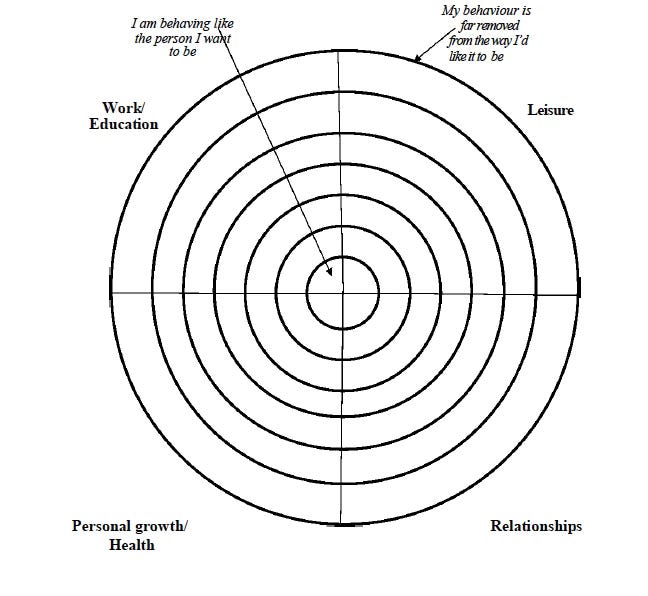
Today, I am excited to introduce a practical instrument from my ACT training that can profoundly benefit you. Known as the Bullseye Tool, this exercise is designed to pinpoint those life areas where your actions may diverge from your core values. By identifying these discrepancies, you empower yourself to take targeted steps toward greater alignment and authenticity.
During my ACT training sessions, our instructors emphasized that the most effective practice ground for these emerging skills is our own lives. I have personally applied the Bullseye Tool multiple times, with one notable instance occurring earlier this year. It helped me recognize the need to adjust certain patterns in my relational dynamics. While I am fortunate to have a robust network of emotional support, the majority of our closest friends and family members reside at a significant distance from us geographically.
Through this tool, I uncovered a key insight: although our practical support systems are spread out, my own reluctance to request assistance was a major barrier. This hesitation resulted in me shouldering excessive responsibilities, making it increasingly challenging to manage my daily load effectively. The Bullseye Tool illuminated this as a specific behavioral pattern ripe for modification. For those of you who, like me, tend toward people-pleasing tendencies and a strong preference for fierce independence, you will appreciate how daunting it can be to initiate the habit of seeking help from others.
What draws me especially to this tool is its precise focus on your behavioral actions in alignment with your ideal self, rather than merely assessing your emotional responses or feelings toward various situations. This distinction encourages a deeper, more actionable form of self-examination.
The Bullseye Tool features four primary life domains: work and education, leisure activities, personal growth and health, and relationships. For each category, you will mark an ‘X’ on the diagram to indicate your current position. Positioning the ‘X’ nearer to the bullseye’s center signifies that your behaviors more closely embody the person you wish to be. Conversely, an ‘X’ placed toward the outer rings indicates a greater disconnect between your actions and your values.
Consider, for instance, your professional or educational environment: Are your actions at work a true representation of the professional you envision? This query shifts the emphasis from your sentiments about your job—such as satisfaction or frustration—to the tangible ways you conduct yourself daily.
In the realm of leisure, the focus turns to how you engage in play, unwind, and derive pleasure from life. The relationships domain encompasses your interactions with a partner, children, parents, extended family, friends, colleagues, and broader social connections. How do you show up for these vital bonds?
Personal growth and health might involve pursuits like spiritual or religious practices, creative endeavors, developing essential life skills, mindfulness meditation, regular physical exercise, mindful nutrition, or tackling health risks such as smoking, excessive alcohol consumption, or other substance-related habits. Each of these areas offers opportunities for behavioral alignment with your deeper values.
My strong advice is to avoid scattering your energy across multiple domains simultaneously, even if several appear misaligned upon initial assessment. Instead, select just one area to prioritize and channel your efforts there intensively. Overwhelm often arises from attempting comprehensive overhauls all at once, so maintain focus on a single target. Develop a set of SMART goals—Specific, Measurable, Achievable, Relevant, and Time-bound—and implement supportive processes to drive progress.
- Specific: Clearly define the exact behavior you aim to change or enhance.
- Measurable: Establish criteria to track your advancement objectively.
- Achievable: Ensure the goal is realistic given your current circumstances and resources.
- Relevant: Confirm it aligns with your overarching values and long-term vision.
- Time-bound: Set deadlines to create urgency and momentum.
Even incremental movements toward the bullseye’s center—those small, consistent steps—will cultivate a profound sense of improved well-being and self-assurance. Over time, these micro-adjustments compound into transformative shifts.
I encourage you to experiment with the Bullseye Tool and share your experiences or reflections. What domains stood out to you? Which one did you choose to focus on first, and why? Your insights could inspire others on similar journeys.
As you embark on this exercise, remember that living in accordance with your values is not about perfection but about direction. The Bullseye Tool provides a visual and intuitive map to guide your behavioral evolution. Whether you are recovering from burnout, navigating career transitions, or simply seeking greater life satisfaction, this approach offers a structured yet flexible path forward.
In my own application earlier this year, addressing my reluctance to ask for help not only lightened my load but also deepened my connections with distant loved ones. We began scheduling more intentional check-ins and exploring virtual ways to provide mutual support, transforming a perceived weakness into a strength. This evolution extended beyond immediate relief, fostering resilience against future stressors.
For those in high-pressure professions or caregiving roles, this tool proves invaluable in preventing the creep of burnout. By routinely checking your bullseye alignment, you maintain proactive vigilance over your most precious resource: your alignment with purpose.
Wishing you clarity, progress, and joy as you navigate toward your bullseye. Have an inspiring week ahead.